

Evaluation of Polyethylene Glycol and Theobroma Bases on the Probiotic Activity of Lactobacillus paragasseri Against Escherichia coli
Barre latérale de l'article
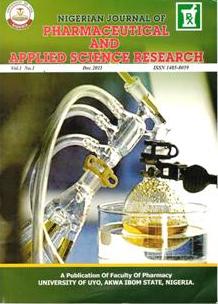
Contenu principal de l'article
Résumé
Background: Escherichia coli is a ubiquitous Gram-negative bacterium with pathogenic potential, necessitating alternative inhibitory strategies. This study evaluated the comparative inhibition of Escherichia coli ATCC 25922 by Lactobacillus paragasseri, JV-V03 in combination with polyethylene glycol and Theobroma in co-culture systems.
Methods: Lactobacillus paragasseri JV-V03 and E. coli ATCC 25922 were characterized using phenotypic and biochemical techniques. Antibacterial activity was determined using the agar overlay method, while co-cultivation assessed comparative E. coli growth in combination with L. paragasseri JV-V03, polyethylene glycol, and Theobroma. Statistical significance was determined using two-way ANOVA.
Results: Characterization confirmed the identity of both isolates. The agar overlay method demonstrated bacteriostatic activity (IZD = 30.8 ± 0.62 mm). Co-cultivation reduced E. coli growth to 0.17 log?? CFU/mL/h (r = 0.728) in the presence of L. paragasseri JV-V03, indicating antagonism. This reduction was enhanced with polyethylene glycol, yielding 9.18 × 10?³ log?? CFU/mL/h (r = 0.203). In contrast, E. coli growth increased to 0.28 log?? CFU/mL/h (r = 0.928) with L. paragasseri JV-V03 and Theobroma, indicating a neutral effect. Differences were significant (p < 0.001).
Conclusion: Lactobacillus paragasseri JV-V03 is a promising probiotic candidate for inhibiting E. coli ATCC 25922, while polyethylene glycol is an effective base for optimizing its antibacterial activity.
Téléchargements
Renseignements sur l'article

Cette œuvre est sous licence Creative Commons Attribution - Pas d'Utilisation Commerciale - Pas de Modification 4.0 International.
Références
REFERENCES
Ibn Awadh H, Ahmed M. In vitro antibacterial activity of selected plant extracts against Escherichia coli and Staphylococcus aureus bacterial strains. Discov Appl Sci 2025;7: 287.
Pilarczyk-Zurek M, Strus M, Adamski P, Heczko PB. The dual role of Escherichia coli in the course of ulcerative colitis. BMC Gastroenterol 2016;16(1):128.
Davies J, Davies D. Origins and evolution of antibiotic resistance. Microbiol Mol Biol Rev. 2010;74(3):417–433.
Wu X, Chen G, Yang L, Lv Z, Wu Y, Liang C, Chen Y, Shao B, Zhang Y, Li H. Comprehensive antibiotic resistome comparison of Escherichia coli from irritable bowel syndrome and ulcerative colitis. Curr Res Microb Sci. 2025;(8): 3-7.
He T, Lykov N, Luo X, Wang H, Du Z, Chen Z, Chen S, Zhu L, Zhao Y, Tzeng C. Protective Effects of Lactobacillus gasseri against High-Cholesterol Diet-Induced Fatty Liver and Regulation of Host Gene Expression Profiles. Int. J. Mol. Sci. 2023; 24:2053.
Jimenez NR, Maarsingh JD, ?aniewski P, Herbst-Kralovetz MM. Commensal Lactobacilli Metabolically Contribute to Cervical Epithelial Homeostasis in a Species-Specific Manner. mSphere. 2023;8(1):2-16.
El-Toukhy HEE, El-Barbary HA, Abdelsamei HM, Nassif MZ. Effects of Lactobacillus gasseri and Lactobacillus plantarum on Escherichia coli and Bacillus cereus in yoghurt model. Journal of Agriculture and Veterinary Science 2021;14(8):55–60.
Zhang J, Li K, Cao T. Duan Z. Characterization of a Lactobacillus gasseri strain as a probiotic for female vaginitis. Sci Rep; 2024 (14):14426.
Stoyancheva G, Chorukova E.Lactobacillus gasseri G7 – a bacteriocinogenic strain isolated from vaginal sample’, Annuaire de l’Université de Sofia “St. Kliment Ohridski 2015; 100(4):154–163.
Kouhdareh J. A novel oxidation strategy using a palladium nanocatalyst for stabilizing bisacodyl in polyethylene glycol suppositories. Sci Rep 2026; 16:11149.
Camilletti AL, Ruiz FO, Pascual LM, Barberis IL. First steps towards the pharmaceutical development of ovules containing Lactobacillus strains: Viability and antimicrobial activity as basic first parameters in vaginal formulations. AAPS PharmSciTech 2018;19(2):886–895.
Kumar A, Kolay A, Havelikar U. Modern aspects of suppositories: A review.E uropean Journal of Pharmaceutical Research 2023;3(4):23–29.
Cheesbrough M. District Laboratory Practice in Tropical Countries, Part 2, Low Price Edition. Cambridge University Press 2010:63-125.
Kaur S, Sharma M. Inhibitory potential of Lactobacillus species isolated from fermented dairy products against Escherichia coli and Staphylococcus aureus. Journal of Gastrointestinal Infections 2013; 3(1):46.
Balouiri M, Sadiki M, Ibnsouda SK.Methods for in vitro evaluating antimicrobial activity: A review. Journal of Pharmaceutical Analysis 2016;6(2):71–79.
Du J, Liu F, Li B, Bian X, Evivie SE, Xu M, Ding X, Huo G.In vitro assessment of probiotic potential of Lactobacillus acidophilus and antagonistic activity against Escherichia coli O157:H7.Journal of Northeast Agricultural University (English Edition) 2017;24(1):59–69.
Hammes WP, Vogel RF. The genus Lactobacillus. In: The Genera of Lactic Acid Bacteria 1995; 2:19–54.
Holzapfel WH, Wood BJB. Lactic Acid Bacteria: Biodiversity and Taxonomy. Wiley-Blackwell 2014:249–353
MacFaddin JF (2000). Biochemical Tests for Identification of Medical Bacteria, 3rd ed. Lippincott Williams & Wilkins, Philadelphia; 2000.p. 57–345.
Holt JG, Krieg NR, Sneath PHA, Staley JT, Williams ST. Bergey’s Manual of Determinative Bacteriology, 9th ed. Williams & Wilkins, Baltimore;1994. p.175–189
Shokryazdan P, Sieo CC, Kalavathy R, Liang JB, Alitheen NB, Jahromi MF Ho YW. Probiotic potential of Lactobacillus strains with antimicrobial activity against some human pathogenic strains. BioMed Research International 2014:1-13
Servin AL (2004). Antagonistic activities of lactobacilli and bifidobacteria against microbial pathogens. FEMS Microbiology Reviews 2004; 28(4): 405–440.
Ouwehand AC, Salminen S, Isolauri E. Probiotics: an overview of beneficial effects. Antonie van Leeuwenhoek 2002;82(4): 279–289.
Christoforou I, Kalatzis A, Siamidi A, Vlachou M, Pispas S, Pippa N. The Ubiquitous Use of Polyethylene Glycol in Pharmaceutical Design and Development: Technological Aspects and Future Perspectives. Nanomaterials 2025; 15:1762.
de Villiers M. Suppository Bases’, in A.H. Kibbe (ed.), Handbook of Pharmaceutical Excipients, 5th edn, American Pharmacists Association / Pharmaceutical Press, Washington, DC; 2009.293 p.